ClinicManager
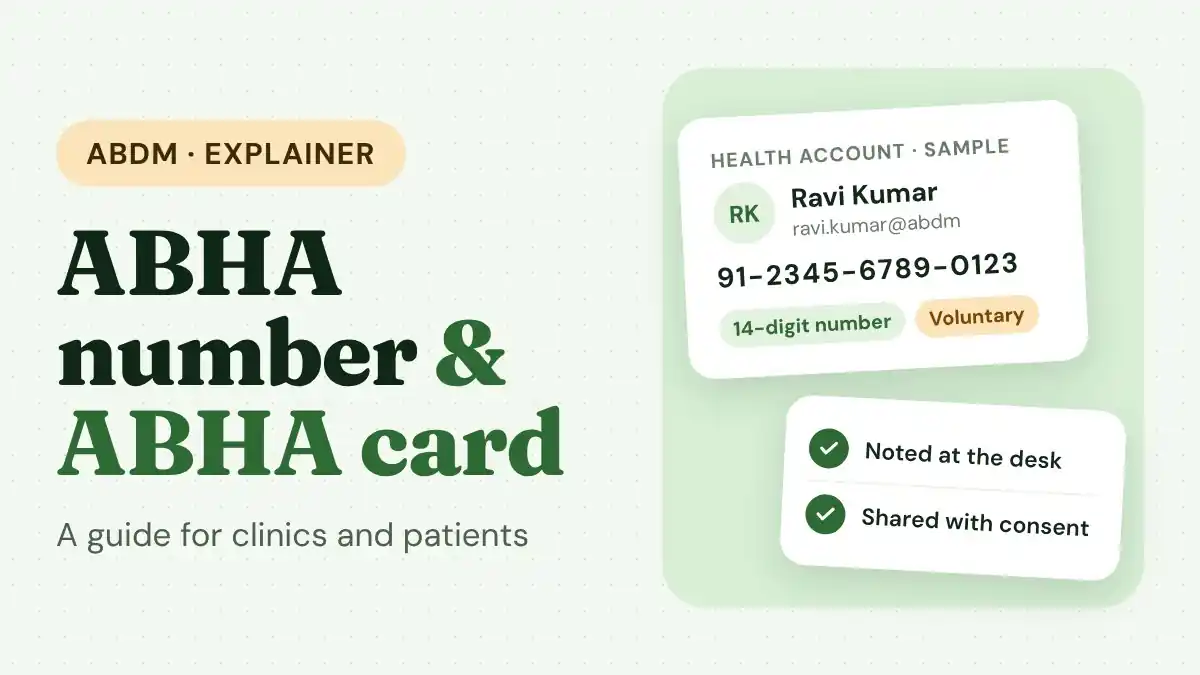
- An ABHA number is a 14-digit health ID under the Ayushman Bharat Digital Mission (ABDM). ABHA stands for Ayushman Bharat Health Account.
- The ABHA card is simply the printable version of that ID. It is not an insurance card, and it is different from the Ayushman card issued under PM-JAY.
- Patients create an ABHA free of charge with Aadhaar or a driving licence, at abha.abdm.gov.in, in the ABHA app or at a registered health facility.
- ABHA is voluntary. A clinic can ask for it, but a patient who doesn’t have one should be treated as usual.
- A clinic can start by recording the ABHA number on each patient’s record. Linking records through ABDM needs HPR and HFR registration and ABDM-enabled software.
More and more patients now walk into clinics with an ABHA card on their phone, and more clinics are being asked whether they “accept ABHA”. The idea is simple, but the terms get mixed up: ABHA number, ABHA address, ABHA card, Ayushman card.
This guide explains what an ABHA number is, how patients create one, and what a clinic actually needs to do with it.
What is an ABHA number?
ABHA stands for Ayushman Bharat Health Account. An ABHA number is a 14-digit number that identifies a person in India’s digital health system, the Ayushman Bharat Digital Mission (ABDM), which is run by the National Health Authority (NHA).
The number lets a patient link health records from different hospitals, clinics and labs to one account, and share them with a doctor when they choose to. According to a government factsheet, more than 90 crore ABHA accounts had been linked to over 100 crore health records by May 2026.
ABHA number, ABHA address and ABHA card
| What it is | Example | |
|---|---|---|
| ABHA number | The 14-digit health ID, generated by the system | 91-2345-6789-0123 |
| ABHA address | A username the patient chooses, used to log in to health record apps and to share records | ravi.kumar@abdm |
| ABHA card | A downloadable card showing the name, ABHA number, ABHA address and a QR code | PDF or image on the patient’s phone |
So “ABHA card” and “ABHA number” refer to the same account. The card is just a convenient way to show the number at a registration desk.
ABHA card vs Ayushman card
This is the most common confusion at the front desk.
| ABHA card | Ayushman card (PM-JAY) | |
|---|---|---|
| What it is | A digital health ID | A health cover card for eligible families |
| Who can get it | Anyone with an Aadhaar or a driving licence | Only families eligible under the scheme |
| What it does | Links and shares health records, with consent | Pays for covered hospital treatment at empanelled hospitals |
| Pays for treatment? | No | Yes, within the scheme’s limits |
A patient with only an ABHA card has no insurance cover from it. If a patient asks whether their ABHA card covers the consultation, the answer is no.
How a patient creates an ABHA number
Creating an ABHA is free. There are three routes.
With Aadhaar
- Go to abha.abdm.gov.in or open the ABHA app, and choose to create an ABHA number.
- Choose Aadhaar, enter the Aadhaar number and give consent.
- Enter the OTP sent to the mobile number linked to Aadhaar.
- Check the details pulled from Aadhaar and choose an ABHA address.
- The 14-digit ABHA number is generated, and the card can be downloaded.
With a driving licence
Patients whose mobile number isn’t linked to Aadhaar, or who prefer not to use Aadhaar, can choose the driving licence option. This route can involve an extra verification step, so it usually takes longer.
At a health facility
ABDM-registered facilities can help patients create an ABHA at the registration desk.
The portal’s screens change from time to time, so follow the steps shown there if they differ from these.
How clinics use ABHA
1. Record it at registration
The simplest step is to ask for the ABHA number when a patient registers, and save it on their record. It costs nothing, needs no integration, and means the number is already there when your clinic connects to ABDM.
2. Faster registration with Scan and Share
Facilities connected to ABDM can display a QR code at the registration counter. The patient scans it with the ABHA app or another ABDM-enabled app and shares their profile, so the desk doesn’t have to type name, age and gender again. The patient gets a token for the queue. As of 18 June 2026, more than 23.21 crore tokens had been issued this way, mostly at large hospitals.
3. Link records to the patient’s ABHA
With ABDM-enabled software, a clinic can link a prescription or report to the patient’s ABHA, so the patient can see it in their health records app and share it with another doctor. Records are shared only with the patient’s consent, and that consent is time-bound and can be withdrawn.
For steps 2 and 3, the clinic must be on the Health Facility Registry and its doctors on the Healthcare Professionals Registry. Our guide to HPR and HFR registration covers both.
What clinics should keep in mind
- ABHA is voluntary. Ask for it, explain the benefit, and carry on as usual if the patient doesn’t have one or doesn’t want to share it.
- Don’t create an ABHA for a patient without asking. Creating one uses the patient’s Aadhaar or licence and needs their consent.
- Treat it as personal data. The ABHA number sits on the patient’s record alongside other personal data covered by the Digital Personal Data Protection Act, 2023. Limit who can see it.
- Check the name matches. If the name on the ABHA differs from your record, confirm with the patient before saving.
Do clinics get paid for using ABHA?
Possibly. The NHA runs the Digital Health Incentive Scheme (DHIS), launched on 1 January 2023, which pays health facilities and software companies for ABHA-linked health records above a monthly threshold. By 18 June 2026, the government had paid out more than ₹107 crore to hospitals under the scheme.
The rates, thresholds and dates have been revised several times. The most recent notice we could find covered April to September 2026, so check the DHIS page on abdm.gov.in for the current terms before you count on it.
Where ClinicManagerPro fits
In ClinicManagerPro, each patient record has a field for the ABHA number, so your front desk can capture it from the first visit. ABHA verification and record linking through ABDM can be set up for your clinic once your registrations and certification are in place. For how records, EMR and EHR fit together, see what is EMR.
Common questions
What is an ABHA number?
An ABHA number is a 14-digit health ID issued under the Ayushman Bharat Digital Mission. ABHA stands for Ayushman Bharat Health Account. It lets a person link and share their health records with their consent.
Is the ABHA card the same as the Ayushman card?
No. The ABHA card is a digital health ID that anyone can create. The Ayushman card is issued under PM-JAY to eligible families and pays for covered hospital treatment. An ABHA card gives no insurance cover.
Is an ABHA number mandatory?
No. Creating an ABHA is voluntary, and a patient can deactivate or delete it. A clinic can ask for it but should treat patients who don’t have one as usual.
What is the difference between an ABHA number and an ABHA address?
The ABHA number is a 14-digit ID generated by the system. The ABHA address is a username the patient chooses, such as name@abdm, used to log in to health record apps and share records.
Can a clinic create an ABHA for a patient?
ABDM-registered facilities can help a patient create one at the registration desk, with the patient’s consent and their Aadhaar or driving licence. Patients can also create it themselves at abha.abdm.gov.in or in the ABHA app.
Does a clinic need special software to accept ABHA?
Not to record it. Any clinic can note the ABHA number on the patient’s record. To verify an ABHA, use Scan and Share or link records, the clinic needs ABDM-enabled software and HFR and HPR registration.