ClinicManager
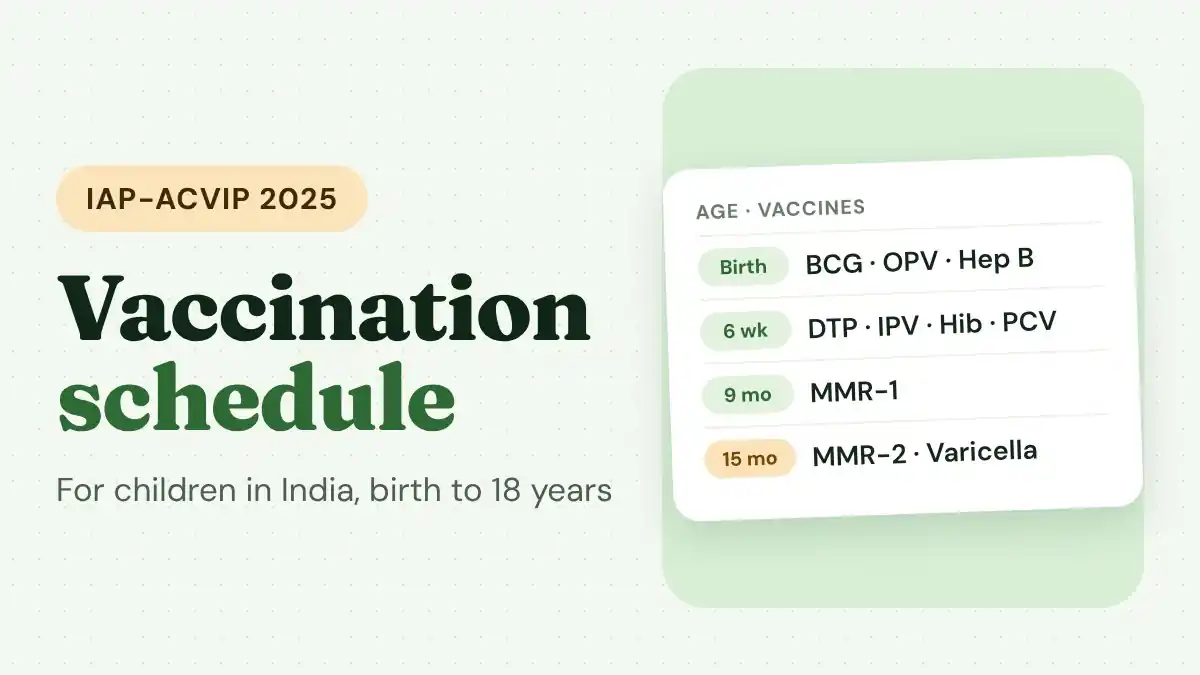
- The latest IAP vaccination schedule is the IAP-ACVIP 2025 timetable, published in Indian Pediatrics in April 2026.
- The routine schedule runs from birth to 18 years, with most doses in the first two years: birth, 6, 10 and 14 weeks, then 6 months to 19 months.
- New in 2025: a single HPV dose for girls aged 9 to under 15, trivalent flu vaccines in place of quadrivalent, and RSV antibodies only for high-risk infants.
- The IAP schedule adds vaccines the free government schedule doesn’t, such as influenza, typhoid conjugate, hepatitis A and varicella.
- For a paediatric clinic, the hard part isn’t knowing the schedule. It’s making sure every child comes back on time.
The IAP vaccination schedule is the immunisation timetable recommended by the Indian Academy of Pediatrics (IAP) through its Advisory Committee on Vaccines and Immunization Practices (ACVIP). Most private paediatricians in India follow it, and parents often ask for it by name.
This guide sets out the current IAP-ACVIP schedule, what changed in the 2025 update, how it differs from the government’s schedule, and how paediatric clinics keep children on track. It summarises the published recommendations for clinics and parents. It isn’t medical advice: the child’s paediatrician decides what each child receives and when.
Which IAP schedule is the latest?
The current version is the IAP-ACVIP Recommended Immunization Schedule 2025. It was published in Indian Pediatrics (2026, volume 63, pages 311 to 324) and appeared online on 9 April 2026. It replaces the 2023 schedule, which was published in February 2024.
The IAP reviews its recommendations regularly, so check the date on any chart you print or share. Many charts online still show 2020-21 or 2023 versions.
The IAP vaccination schedule 2025: full chart
These are the vaccines for routine use, by age. Ages are completed weeks, months or years.
| Age | Vaccines | Notes |
|---|---|---|
| Birth | BCG, OPV, Hepatitis B-1 | BCG before discharge. OPV as soon as possible after birth. Hepatitis B within 24 hours of birth. |
| 6 weeks | DTwP/DTaP-1, IPV-1, Hib-1, Hepatitis B-2, Rotavirus-1, PCV-1 | Either DTwP or DTaP can be used for the primary series. IPV is given at 6, 10 and 14 weeks. |
| 10 weeks | DTwP/DTaP-2, IPV-2, Hib-2, Hepatitis B-3, Rotavirus-2, PCV-2 | One rotavirus vaccine (RV1) uses 2 doses; the others use 3. |
| 14 weeks | DTwP/DTaP-3, IPV-3, Hib-3, Hepatitis B-4, Rotavirus-3, PCV-3 | The extra hepatitis B dose within a combination vaccine is considered safe. |
| 6 months | Influenza (IIV)-1 | 0.5 mL dose from 6 months. |
| 7 months | Influenza (IIV)-2 | Then once a year until 5 years of age. |
| 6 to 9 months | Typhoid conjugate vaccine | Single dose. No booster recommended. |
| 9 months | MMR-1 | First dose of measles, mumps and rubella. |
| 12 months | Hepatitis A | Single dose for the live vaccine. The inactivated vaccine needs two doses. |
| 15 months | MMR-2, Varicella-1, PCV booster | First varicella dose. |
| 16 to 18 months | DTwP/DTaP-B1, Hib-B1, IPV-B1 | First boosters. |
| 18 to 19 months | Hepatitis A-2, Varicella-2 | Hepatitis A-2 only for the inactivated vaccine. |
| 4 to 6 years | DTwP/DTaP-B2, IPV-B2, MMR-3 | Second boosters and third MMR dose. |
| 9 to under 15 years | HPV | Girls: a single dose. Boys: two doses, 6 months apart. |
| 10 years | Tdap | Given even if Tdap was used earlier as the second DTP booster. |
| 15 to 18 years | HPV | Three doses at 0, 2 and 6 months if not given earlier. |
| 16 to 18 years | Td/Tdap | Adolescent booster. |
Counting every dose from birth to 6 years, a child on the IAP schedule visits the clinic many times in the first two years alone. That is why the schedule is as much a scheduling problem for clinics as a medical one.
What changed in the 2025 update
The 2025 schedule keeps the same structure as 2023 but changes four recommendations:
- Influenza: trivalent vaccines (two influenza A strains and one B/Victoria strain) may replace quadrivalent vaccines. Annual vaccination is still advised up to 5 years, and longer for children at high risk.
- HPV: healthy girls aged 9 to under 15 can now receive a single dose. Boys aged 9 to 15 still receive two doses. People over 15, and immunocompromised children of any age, receive three.
- RSV antibody (nirsevimab): not recommended for every infant yet. It is limited to high-risk infants, after discussion with parents, until there is more Indian data on RSV.
- Rabies: post-exposure vaccination follows a five-dose intramuscular schedule on days 0, 3, 7, 14 and 28, with immunoglobulin or monoclonal antibody depending on the type of exposure.
IAP schedule vs the government schedule
India runs two schedules side by side.
- The National Immunization Schedule, under the Universal Immunization Programme (UIP), is the government’s schedule. Its vaccines are free at government health facilities.
- The IAP-ACVIP schedule is followed mainly by private paediatricians. It includes the core UIP vaccines plus others, such as influenza, typhoid conjugate, hepatitis A and varicella, and often uses combination vaccines that mean fewer injections.
Many families mix the two, for example taking some doses at a government centre and others at a private clinic. When a child moves from the government schedule to the IAP schedule, the IAP gives specific guidance on polio (IPV) doses, so the paediatrician should check which doses the child has already had.
How paediatric clinics keep children on schedule
Knowing the schedule is easy. Making sure hundreds of children come back for each dose is the hard part. Paediatric clinics usually need four things:
- A dose record for every child: which vaccines were given, on which date, which brand and batch, and what is due next.
- A due and overdue list: so the front desk can call or message parents before a child falls behind.
- A catch-up plan: for children who arrive with missing doses, so the remaining doses are tracked like a course.
- Prepaid packages: many parents prefer to pay once for the first year or the full schedule, and the clinic needs to know how many doses are left on each package.
In ClinicManagerPro’s paediatric clinic software, the IAP schedule is set up as a 14-dose course on each child’s record, with a 6-dose catch-up course for missed doses. Children who are due or overdue appear on a list for the front desk, and vaccination and first-year packages show the doses used and remaining. If you want reminders to reach parents automatically, WhatsApp and SMS reminders can be connected for your clinic.
A paper vaccination card is still useful for parents. But the clinic’s own record is what lets you see, every morning, which children need to come in this week.
Common questions
What is the latest IAP vaccination schedule?
The latest is the IAP-ACVIP Recommended Immunization Schedule 2025, published in Indian Pediatrics in 2026 (volume 63, pages 311 to 324). It replaces the 2023 schedule.
What vaccines are given at birth under the IAP schedule?
BCG, oral polio vaccine (OPV) and the first dose of hepatitis B. BCG is given before discharge, OPV as soon as possible after birth, and hepatitis B within 24 hours of birth.
What changed in the IAP schedule in 2025?
Trivalent influenza vaccines may replace quadrivalent ones, healthy girls aged 9 to under 15 can receive a single HPV dose, RSV antibodies are limited to high-risk infants, and rabies post-exposure vaccination follows a five-dose schedule.
What is the difference between the IAP schedule and the government schedule?
The government’s National Immunization Schedule offers core vaccines free at government facilities. The IAP schedule, followed mostly by private paediatricians, adds vaccines such as influenza, typhoid conjugate, hepatitis A and varicella.
How can a paediatric clinic track every child's vaccinations?
Keep a dose record for each child, a due and overdue list for the front desk, a catch-up course for missed doses and a record of prepaid packages. Paediatric clinic software can hold all four on each child’s record.
This article summarises published IAP-ACVIP recommendations for general information. It is not medical advice. Decisions about a child’s vaccinations should be made with their paediatrician.
- IAP-ACVIP Recommended Immunization Schedule (2025), Indian Pediatrics 2026;63:311–324
- IAP-ACVIP Recommended Immunization Schedule (2023), Indian Pediatrics 2024;61:113–125
- Immunization schedules: NIP and IAP (IAP Presidential Action Plan 2026)
- Paediatric clinic software: vaccination courses, packages and recalls