 ClinicManager
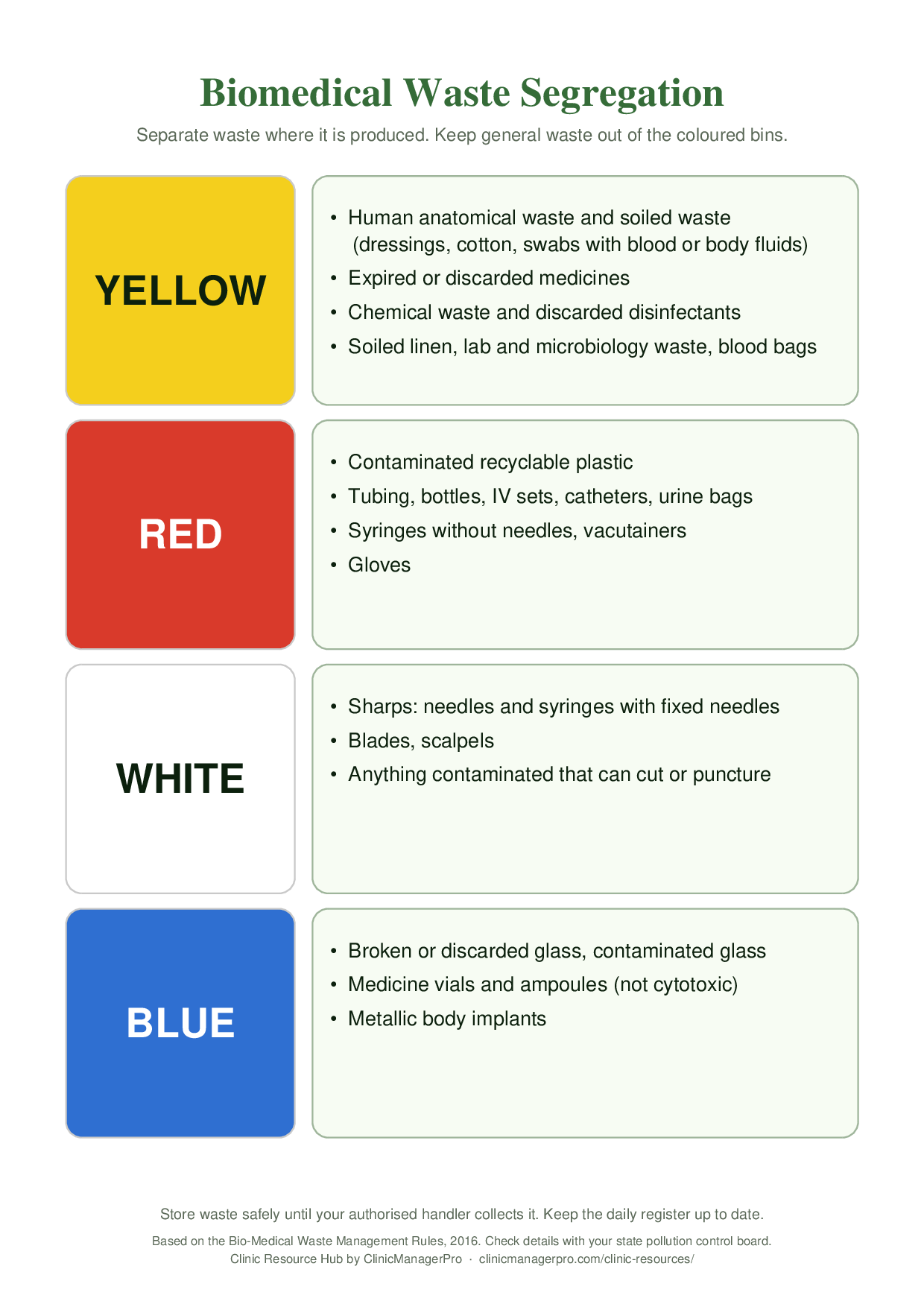
Free A4 poster. Print it in colour and put it up beside your bins.
- Every clinic that handles biomedical waste, whatever the quantity, needs authorisation from its state pollution control board under Rule 10.
- Waste is separated into four colours: yellow, red, white and blue.
- Keep a daily biomedical waste register and file the annual report in Form-IV by 30 June.
- Most clinics hand their waste to a common treatment facility that collects it on a schedule.
The Bio-Medical Waste Management Rules, 2016 were published by the central government through G.S.R. 343(E) on 28 March 2016. This guide gives the colour code in plain words, the duties that fall on a clinic, and the paperwork to keep.
Does this apply to a small clinic?
Yes. State pollution control boards state that every occupier handling biomedical waste, irrespective of quantity, must obtain authorisation under Rule 10. Bedded and non-bedded facilities both apply, using Form-II.
Colour code at a glance
| Colour | What goes in |
|---|---|
| Yellow | Anatomical waste, soiled waste, expired or discarded medicines, chemical waste and discarded disinfectants, soiled linen, laboratory and microbiology waste and blood bags. Liquid chemical waste and infected secretions also belong to the yellow category. |
| Red | Contaminated recyclable plastic: tubing, bottles, IV sets, catheters, urine bags, syringes without needles, vacutainers and gloves. |
| White | Sharps: needles, syringes with fixed needles, blades, scalpels and anything else contaminated that can cut or puncture. |
| Blue | Broken or discarded glass, contaminated glass, medicine vials and ampoules (except those contaminated with cytotoxic waste) and metallic body implants. |
Day-to-day steps for a clinic
- Separate waste where it is produced, and keep general waste out of the coloured bins.
- Put the colour chart up where staff work, so nobody has to guess.
- Store the waste in a safe, ventilated and secured place until your authorised handler collects it.
- If you produce laboratory or microbiological waste, blood samples or blood bags, pre-treat them on site following WHO or NACO guidelines.
- Train every staff member who handles the waste at least once a year, and keep a record.
- Immunise the staff who handle it, as the national immunisation policy or health ministry guidelines prescribe.
Records and reports
| Record | What it involves |
|---|---|
| Daily register | Keep the biomedical waste register up to date every day. |
| Annual report | File Form-IV with your state pollution control board by 30 June, covering January to December of the previous year. |
| Accidents | Report major accidents, such as a fire during handling, in Form-I. |
| Equipment | If you run treatment equipment on site, keep its operating records for five years. |
| Staff health | Keep health check-up records for staff who handle the waste. |
Confirm with your state board
This guide summarises the Rules as state pollution control boards describe them. Check these with your board, because they matter for compliance and some differ by state:
- Container and bag specifications for each colour
- Treatment and disposal options for each category
- Any amendment to the Rules since 2016
- Authorisation fees, validity and the application portal for your state
Frequently asked questions
Do I need a separate waste handler?
Most clinics hand their waste to a common biomedical waste treatment facility that collects it on a schedule. Your state pollution control board can tell you which operators cover your area.
Is the daily register the same as the annual report?
No. The register is a daily record kept at the clinic. The annual report is a yearly summary filed with the board in Form-IV.
What is the penalty for not following the rules?
Penalties come from the Rules and the Environment (Protection) Act, 1986. Your state pollution control board can tell you the current provisions.
- Official source: Central Pollution Control Board: Bio-Medical Waste Management Rules, 2016
- Last checked on 18 November 2026
Part of the Clinic Resource Hub: general information for clinics, not legal or medical advice, and separate from ClinicManagerPro's product help. ClinicManagerPro is not a government body and this is not an official site.