ClinicManager
- Consultations, diagnosis, treatment and diagnostic tests by a clinic or a registered practitioner are exempt from GST.
- Cosmetic and plastic surgery, hair transplants and purely cosmetic treatments are taxable, usually at 18%.
- Medicines sold at your pharmacy counter carry GST. Since 22 September 2025 most are at 5%, and a notified list of life-saving drugs is nil.
- A clinic that only gives exempt services doesn’t need GST registration. Add a pharmacy or cosmetic work and your exempt income counts towards the ₹20 lakh limit.
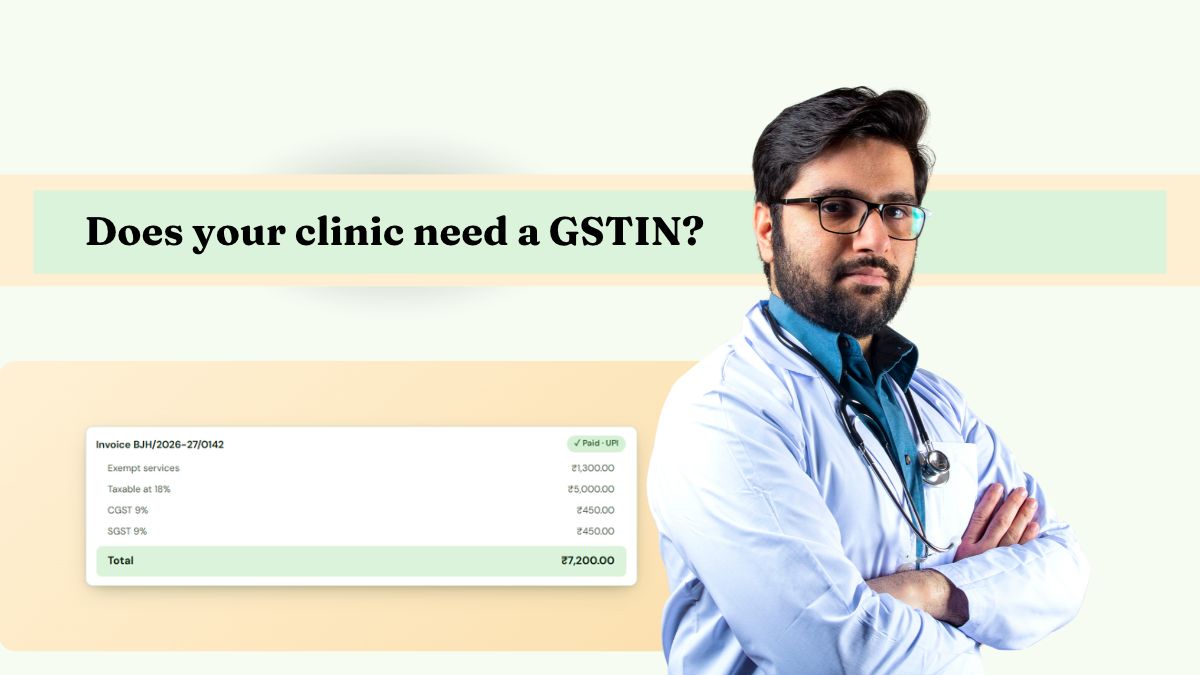
- One patient bill can carry exempt and taxable lines together, as an invoice-cum-bill of supply.
- Doctor consultations are reported under SAC 999312. A doctor’s non-medical income, such as fees for lectures or endorsements, is generally taxable at 18%.
Most clinic owners hear “healthcare is exempt from GST” and stop there. That’s mostly right, but not completely. The moment your clinic sells medicines, offers an aesthetic treatment or crosses into cosmetic work, part of your income becomes taxable, and that can change whether you need a GSTIN at all.
This guide to GST for doctors and clinics explains what is exempt, what isn’t, which SAC codes to use, when you need to register and how to bill a patient whose visit includes both.
The short answer: most clinic services are exempt
GST exempts “health care services by a clinical establishment, an authorised medical practitioner or para-medics”. The exemption sits at entry 74 of Notification 12/2017-Central Tax (Rate), with matching notifications under each state’s GST law.
Health care services here means diagnosis, treatment or care for illness, injury, deformity, abnormality or pregnancy, in any recognised system of medicine in India. It also covers taking a patient to and from a clinical establishment. So an OPD consultation, a dressing, a minor procedure, a scan or a blood test at your clinic carries no GST.
Who the exemption covers
The exemption depends on who gives the service, so it helps to know the three terms the law uses:
- Clinical establishment: a hospital, nursing home, clinic, sanatorium or any other institution that offers diagnosis, treatment or care for illness. Diagnostic centres and labs are included.
- Authorised medical practitioner: a practitioner registered with a council of a recognised system of medicine. Allopathy, Ayurveda, Homoeopathy, Siddha, Unani, Yoga and Naturopathy are all recognised systems, so an Ayurveda doctor’s treatment is covered just like an allopathic doctor’s.
- Para-medics: trained health care staff such as nurses, technicians and physiotherapists working in the care of patients.
If you run a dental, dermatology, physiotherapy, ENT, orthopaedic, paediatric, general or Ayurveda clinic that diagnoses and treats patients, your core services fall inside this exemption.
The exemption also reaches doctors who work for someone else. CBIC Circular 32/06/2018-GST clarified that senior doctors, consultants and technicians hired by a hospital provide exempt health care services, whether they are employees or not. A visiting consultant’s fee from a hospital therefore carries no GST.
What stays taxable inside a clinic
The exemption covers health care, not everything a clinic sells. These are the lines that most often carry GST:
| What you charge for | GST | Why |
|---|---|---|
| Consultations, procedures, treatment, follow-ups | Exempt | Health care service, entry 74 |
| Diagnostic tests, scans, lab work | Exempt | Diagnosis is part of health care |
| Medicines given to in-patients during treatment | Exempt | Part of one composite health care service |
| Food given to admitted patients as advised by the doctor | Exempt | Part of the health care service (Circular 32/06/2018) |
| Ambulance transport of a patient | Exempt | Covered by the same entry 74 |
| Hair transplant, cosmetic or plastic surgery | Taxable, usually 18% | Excluded from health care, unless it restores or reconstructs a body part or function affected by illness, injury, a congenital defect or deformity |
| Purely cosmetic treatments, such as facials or skin brightening | Usually taxable at 18% | Not treating an illness or condition |
| Medicines sold at your pharmacy counter | Mostly 5%, some nil | A sale of goods, taxed at the medicine’s own rate |
| Non-ICU hospital rooms above ₹5,000 a day | 5%, no input tax credit | Applies to hospitals with in-patient rooms, since July 2022 |
| Skincare products, supplements, devices sold separately | At the product’s rate | A sale of goods, not a service |
| Food sold to visitors, attendants or out-patients | Taxable | Not part of a patient’s treatment |
| A doctor’s lectures, training, endorsements or research reports | Generally 18% | Not health care services |
From 22 September 2025, the GST Council removed the 12% rate for medicines. Most medicines, including Ayurvedic and homoeopathic medicines, moved to 5%, and 36 notified life-saving drugs became nil. If your pharmacy price list or software still shows 12% on medicines, it needs updating. See the new GST rates on medicines.
SAC codes for clinic services
Every line on a GST document carries a code. Services use SAC codes, and health services sit under heading 9993. The ones a clinic uses most:
| SAC | Covers |
|---|---|
| 999311 | In-patient services |
| 999312 | Medical and dental services, including doctor consultations |
| 999313 | Childbirth and related services |
| 999314 | Nursing and physiotherapy services |
| 999315 | Ambulance services |
| 999316 | Medical laboratory and diagnostic imaging |
| 999317 | Blood, sperm and organ bank services |
| 999319 | Other human health services, including Ayurveda, homoeopathy, Unani and naturopathy |
On invoices and in GSTR-1, businesses with an aggregate turnover up to ₹5 crore report the 4-digit heading (9993). Above ₹5 crore, the full 6-digit code is required. Medicines sold at your pharmacy use HSN codes instead, usually 3003 or 3004.
Specialty by specialty
The line between treatment and cosmetic work matters most in a few specialties:
- Dermatology: treating a skin disease is health care. In 2025, Kerala’s Authority for Advance Ruling held that treatments for skin conditions given by a dermatology clinic are exempt. Laser hair removal, facials and similar aesthetic work done for appearance alone are generally taxable.
- Dental: treating pain, decay, infection or injury is exempt. Work done only to change how teeth look is where questions arise.
- Ayurveda: treatment by a registered Ayurveda practitioner is exempt. Wellness or spa-style packages that don’t treat a condition may not be.
- Physiotherapy: rehabilitation and treatment for injury or illness is health care. Fitness or general wellness sessions are a grey area.
Where a treatment could be either medical or cosmetic, what you record matters: the diagnosis, the reason for treatment and the doctor’s notes. Ask your chartered accountant how to treat the services you offer.
Do you need GST registration?
It depends on whether any of your income is taxable.
- Only exempt services: no registration needed. Section 23 of the CGST Act excludes anyone who supplies only exempt services, however large the turnover.
- Exempt services plus anything taxable: registration depends on your aggregate turnover, and aggregate turnover includes your exempt income. Once the total crosses ₹20 lakh in a year (₹10 lakh in some special-category states), you need to register.
For example, a clinic with ₹30 lakh of consultation income and ₹3 lakh of pharmacy sales has an aggregate turnover of ₹33 lakh. That crosses the limit, so the clinic must register, even though most of its income is exempt.
Once you’re registered, you charge GST only on the taxable lines. Your consultations stay exempt.
How to bill a patient for both
A registered clinic issues a tax invoice for taxable supplies and a bill of supply for exempt ones. You don’t have to hand a patient two pieces of paper, though. Rule 46A of the CGST Rules lets a registered person supplying both taxable and exempt items to an unregistered person, such as a patient, issue one invoice-cum-bill of supply for everything.
On that single bill, each line shows its own treatment:
- Exempt lines, such as the consultation, show no GST.
- Taxable lines show the rate and the tax.
- Within your state, the tax is split equally into CGST and SGST. For a patient from another state, it’s charged as IGST.
Here is how a combined bill for one visit to a skin clinic could look:
| Item | SAC | Value | GST |
|---|---|---|---|
| Dermatology consultation | 999312 | ₹800 | Exempt |
| Chemical peel (cosmetic) | 999722 | ₹2,000 | CGST 9% ₹180 + SGST 9% ₹180 |
| Total | ₹3,160 |
The bill also needs the clinic’s name, address and GSTIN, a serial number, the date and the patient’s name.
One more point: you can’t claim input tax credit on purchases used for exempt services. If your purchases serve both kinds of income, your accountant will apportion the credit. Many medical devices and consumables moved to the 5% rate in September 2025, which lowers the GST a clinic pays on supplies it can’t claim back.
How ClinicManagerPro handles GST
We built ClinicManagerPro’s billing around these rules:
- Every service in your price list has its own GST rate, so exempt and taxable work go on the same invoice without manual changes.
- CGST and SGST, or IGST for a patient from another state, are calculated automatically.
- Pharmacy items carry an HSN code and tax rate, and stock is tracked batch by batch.
- Each branch has its own GSTIN and invoice series, which helps if your branches are in different states.
The rates in your price list are yours to set, so confirm them with your accountant when you set up. Read more in our guide to GST on invoices.
Choosing clinic software? Our 10-point buyer’s guide shows what to check before you decide.
This article explains the rules as of November 2026. It is general information, not tax advice. GST rates and rulings change, so confirm how they apply to your clinic with a chartered accountant.
Common questions
Is a doctor's consultation fee subject to GST?
No. Consultations by a registered medical practitioner or a clinic are health care services and are exempt under entry 74 of Notification 12/2017-Central Tax (Rate).
Does a clinic need GST registration?
Not if it only provides exempt health care services. If it also sells medicines, cosmetic treatments or other taxable items, it must register once its total turnover, including exempt income, crosses ₹20 lakh in a year (₹10 lakh in some special-category states).
What is the GST rate on medicines sold by a clinic pharmacy?
Since 22 September 2025, most medicines are taxed at 5%, and 36 notified life-saving drugs are nil. Medicines given to in-patients as part of their treatment are part of the exempt health care service.
Is GST charged on cosmetic treatments at a skin clinic?
Usually, yes. Hair transplants, cosmetic and plastic surgery, and treatments done only for appearance are taxable, generally at 18%. Treating a skin disease is health care and stays exempt.
What is the SAC code for a doctor's consultation?
999312, which covers medical and dental services. Businesses with a turnover up to ₹5 crore can show the 4-digit heading 9993 instead.
Is a visiting consultant's fee from a hospital taxable?
No. CBIC Circular 32/06/2018-GST clarified that services by senior doctors, consultants and technicians hired by a hospital are exempt health care services, whether or not they are employees.
Can exempt and taxable services go on one bill?
Yes. When the patient isn’t GST-registered, Rule 46A of the CGST Rules allows a single invoice-cum-bill of supply that lists both, with GST shown only on the taxable lines.
- Kerala AAR on GST for dermatological treatments (Taxguru)
- FAQs on the September 2025 GST rate changes (PIB)
- Tax invoice and other documents, including invoice-cum-bill of supply (GST Council)
- 5% GST on hospital rooms above ₹5,000 a day (Medical Dialogues)
- Circular 32/06/2018-GST on health care services (CBIC)
- GST on healthcare services: an overview (Taxguru)