ClinicManager
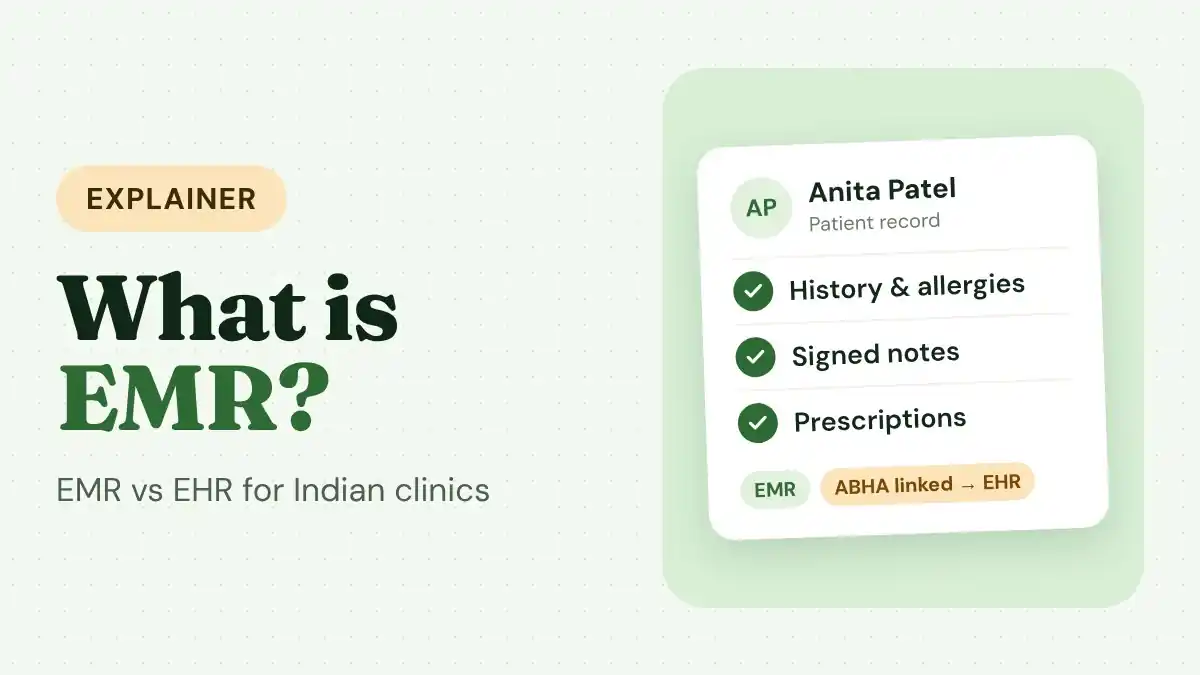
- An EMR (electronic medical record) is the digital version of a patient’s chart inside one clinic: history, notes, prescriptions and reports.
- An EHR (electronic health record) is a record that can be shared across clinics, hospitals and labs. In India, that sharing happens through ABDM, using the patient’s ABHA.
- India’s EHR Standards were notified by the Health Ministry in 2016, and medical council rules already ask doctors to computerise records for quick retrieval.
- For a clinic, a good EMR is the first step to an EHR: structured notes, locked records, data stored in India and the ability to connect to ABDM.
EMR stands for electronic medical record. It is the digital version of the paper case sheet: everything a clinic records about a patient, kept in software instead of files and registers.
The term is often used alongside EHR, and the two are easy to confuse. This guide explains what an EMR is, how it differs from an EHR, what the rules in India say, and what a clinic should look for in EMR software.
What is EMR?
An EMR holds the clinical record of a patient within one practice. A typical EMR includes:
- Patient details, medical history and allergies
- Consultation notes, diagnoses and treatment plans
- Prescriptions
- Lab reports, scans and other documents
- Vaccinations, procedures and follow-ups
The point of an EMR is that a doctor can see a patient’s full history in seconds, instead of searching a shelf of files, and that the record can’t be lost, misread or quietly changed.
EMR vs EHR: the difference
| EMR (electronic medical record) | EHR (electronic health record) | |
|---|---|---|
| Scope | One clinic or practice | Across clinics, hospitals, labs and pharmacies |
| Who sees it | That clinic’s doctors and staff | Any provider the patient allows |
| Main purpose | Running care inside the clinic | Continuity of care wherever the patient goes |
| In India | Kept in the clinic’s software | Shared through ABDM, linked to the patient’s ABHA |
| Needs | Good clinic software | Standards, patient consent and ABDM-enabled software |
In short, an EMR is a clinic’s record of a patient, and an EHR is the patient’s record across the health system. Every EHR is built from EMRs: if a clinic doesn’t keep good digital records, there is nothing to share.
You will also see PHR (personal health record). That is the patient’s own view of their records, for example in an ABHA app.
What the rules in India say
EHR Standards for India
The Ministry of Health and Family Welfare first notified Electronic Health Record Standards for India in September 2013 and revised them in December 2016. The 2016 standards set out how health records should be identified, coded, exchanged and secured, using international standards such as SNOMED CT for clinical terms, LOINC for lab tests, HL7 and DICOM for data and image exchange, and specific requirements for encryption, access control and audit trails. The National Resource Centre for EHR Standards (NRCeS) at C-DAC Pune supports adoption.
Medical council rules on records
The Indian Medical Council (Professional Conduct, Etiquette and Ethics) Regulations, 2002 ask doctors to keep indoor patients’ records for three years from the start of treatment, and to provide copies within 72 hours when a patient or authority asks for them. The same regulations say efforts should be made to computerise medical records for quick retrieval.
ABDM
Under the Ayushman Bharat Digital Mission, patients have an ABHA number (health ID), doctors register on the Healthcare Professionals Registry and facilities on the Health Facility Registry. Clinics using ABDM-enabled software can link records to a patient’s ABHA, with the patient’s consent, so they become part of the patient’s EHR. Our guide to HPR and HFR registration explains the registration steps.
The DPDP Act
Patient records are personal data under the Digital Personal Data Protection Act, 2023. A clinic needs consent to process them, must protect them and must handle patients’ requests about their data. Digital records make this easier to do properly than paper files left on a desk.
What to look for in EMR software
| Check | Why it matters |
|---|---|
| Notes in your specialty’s format | A dental chart, a physio session note and a GP’s SOAP note are different. Generic forms slow doctors down. |
| Records that lock once signed | Signed notes shouldn’t change. Corrections should be added as amendments, so the record holds up later. |
| Allergy checks on prescriptions | The software should warn the doctor before prescribing something the patient is allergic to. |
| Documents on the record | Lab reports, scans and referral letters should sit with the notes, not in a separate folder. |
| Role-based access | Front desk staff shouldn’t read clinical notes. |
| Data stored in India | Simplifies DPDP compliance and patients’ trust. |
| ABHA and ABDM readiness | The record should hold the patient’s ABHA number, with a path to ABDM linking. |
| Full export | Your records should never be locked in. You should be able to export everything. |
EMR software or a full clinic system?
Some EMR products only hold clinical notes. Most clinics are better served by a system where the EMR is connected to the rest of the visit: the appointment, the queue token, the prescription, the invoice and the follow-up. That is usually called a patient management system or clinic management software.
ClinicManagerPro’s EMR keeps one record per patient with history, allergies and the ABHA number, notes in your specialty’s format that lock once signed, prescriptions with allergy checks, and documents, all stored in Mumbai. The same record connects to appointments, billing and follow-ups.
Common questions
What is EMR?
EMR stands for electronic medical record. It is the digital record of a patient kept by one clinic or practice, including history, allergies, notes, prescriptions and reports.
What is the difference between EMR and EHR?
An EMR is a clinic’s own record of a patient. An EHR is a record that can be shared across clinics, hospitals and labs. In India, EHR sharing happens through ABDM, using the patient’s ABHA and consent.
Is EMR mandatory for clinics in India?
There is no single national rule that every clinic must use an EMR, but medical council regulations ask doctors to make efforts to computerise records, and some states and schemes increasingly expect ABDM-linked digital records.
What are the EHR standards for India?
The Health Ministry notified EHR Standards for India in 2013 and revised them in 2016. They cover patient identification, clinical coding such as SNOMED CT and LOINC, data exchange such as HL7 and DICOM, and security requirements.
How long should a clinic keep patient records?
Medical council regulations ask doctors to keep indoor patients’ records for at least three years from the start of treatment. Other rules, such as tax rules, may require longer for certain records, so check with your advisor.
- EHR Standards for India and NRCeS (C-DAC Pune)
- Electronic Health Record Standards for India, 2016 (Vikaspedia, MoHFW)
- Indian Medical Council (Professional Conduct, Etiquette and Ethics) Regulations, 2002 (NMC)
- Ayushman Bharat Digital Mission: India’s digital health backbone (PIB, July 2026)
- Digital Personal Data Protection Act, 2023 (Digital India, MeitY)